
Ada County Deed Records by Instrument Type
The Ada County Clerk, Auditor, Recorder accepts deeds, deeds of trust, reconveyances, liens, judgments, easements, plats, surveys, and annexation instruments for recording. The deed form itself describes the transfer being recorded. Related instruments then secure, release, restrict, or clarify an interest in the land.
| Deed Type | What It Does | Common Use |
|---|---|---|
| Warranty deed | Conveys the stated ownership with expressed warranties | Ordinary sale transfer |
| Quitclaim deed | Conveys whatever interest the grantor has | Family or title cleanup |
| Trustee deed | Records a transfer by a trustee under stated authority | Trust or deed-of-trust event |
| Personal representative deed | Conveys estate land under probate authority | Estate administration |
| Tax deed | Records a statutory tax-deed transfer | Delinquent-tax property |
A deed transfer is not the same as a deed of trust or lien. Those filings can burden land without conveying ownership at all. Read the title, parties, legal description, and any linked releases before drawing a conclusion.
Search the Ada Recorder Index with Verified Fields
The Records Public Access Web is the official Tyler-hosted catalogue for recorded instruments. Use only the search fields the county itself documents, since the form offers options beyond those.
| Field | Use | Limit |
|---|---|---|
| Instrument number | Retrieve a known filing | Length changes by era |
| Party information | Search grantor or grantee | Try spelling variants |
| Parcel number | Match land when indexed | Not every historic filing links a parcel |
| Recording date | Possible date filter | Live control was not verified |
The official sources publish no start year for online coverage or image access. Ask the Recorder before assuming a date that the county has never stated.
The Ada Deed Index Is a Catalogue
The Recorder's own disclaimer compares its index to a library card catalogue. Data can change. Spelling variants matter, and a search result never replaces the filed document itself. Short index entries leave out terms, exhibits, signatures, acknowledgments, and sometimes the full legal description. Enter the Recorder search through the official screen.
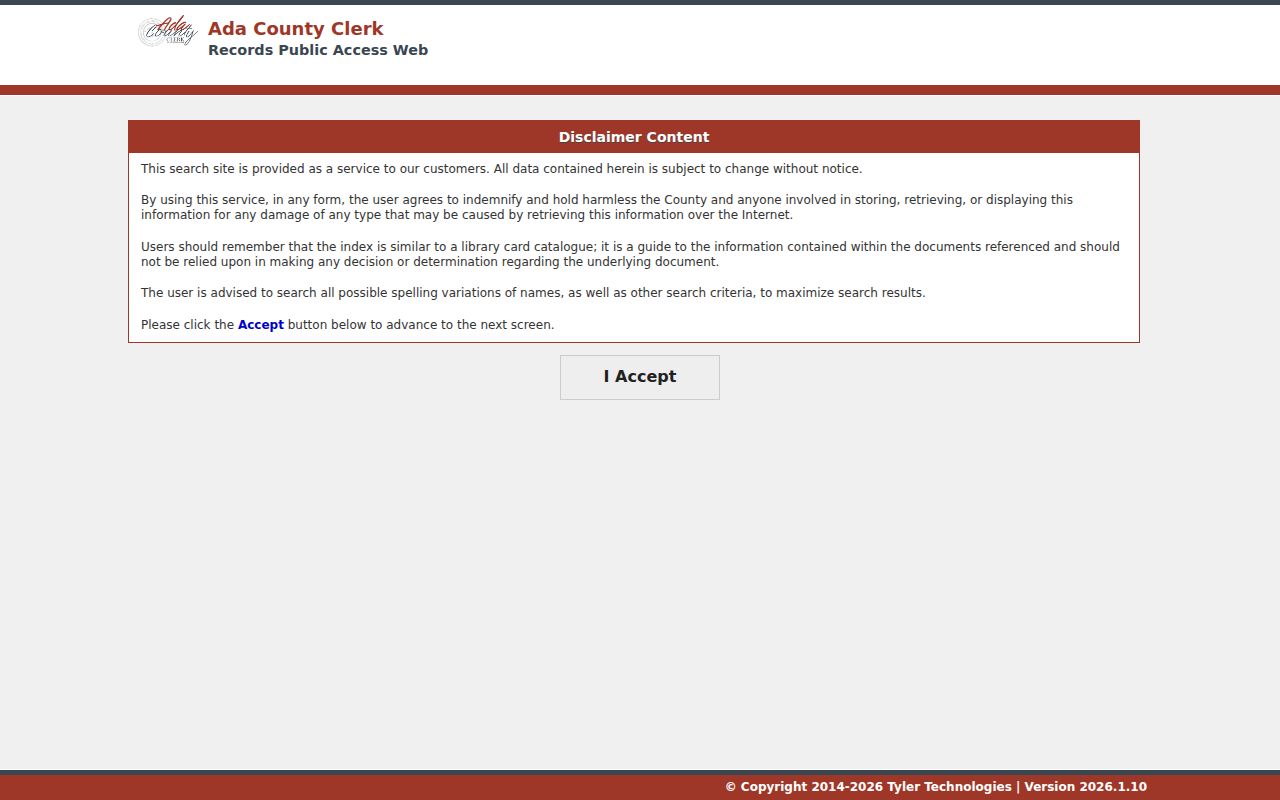
The captured disclaimer defines the index's role before any deed records search begins.
Ada Instrument Numbers Changed Across Eras
Ada County's corner-record help documents a local numbering quirk worth knowing before any deed search. Instruments carried six digits from 1968 through 1975. The count then expanded to seven, eight, nine, and ten digits as the system grew. Since July 13, 2014, instrument numbers begin with the recording year. Never pad a short number to mimic a newer format. Search the number in the form recorded. Then confirm the hit with dates, party names, and the legal description.
Follow Ada County's Grantor-Grantee Trail
A grantor transfers the stated interest, and a grantee receives it. Read both roles on every instrument you open. Then take the prior grantor's name as your next backward search instead of treating one deed as the whole chain of title.
- Use the Assessor owner snapshot or a known instrument to locate the latest likely acquisition deed.
- Open it and verify the parcel or legal description before saving grantor and grantee.
- Search the grantor as an earlier grantee with spelling and entity variants.
- Repeat while noting probate orders, plats, splits, and related instruments.
- Move to staff and Archives holdings when the web index does not supply the needed era.
- Grantor
- The party conveying the stated interest.
- Grantee
- The party receiving the stated interest.
- Chain of title
- The linked sequence of recorded conveyances for the same land.
- Book and page
- An older recorded reference used alongside instrument numbers.
Note: Probate and estate filings can interrupt a simple buyer-seller pattern, so related court and recorded instruments may matter to the chain.
Ada County's 1865-1973 Microfilm Trail
The Idaho State Archives Ada County guide covers county records from 1865 through 1973. Its microfilm holds deeds, homesteads, judgments, wills, guardianships, assessments, taxes, and related material. Some chains predate web coverage. This is the reliable fallback. It beats a guess. Bring names, dates, subdivision, legal description, and book and page clues. Archives holdings can connect an older volume to a later reference. No one should pretend all Ada County property records sit online.
Recorded Plats Anchor Ada County Deeds
Local plat citations include Country Grove Park at Book 45, Page 3669, Utter Subdivision at Book 10, Page 509, and Tealwood at Book 59, Page 5823. Moon Lake Ranch is cited at Book 72, Page 7355. These are strong anchors for matching a deed to its subdivision. When a deed names a lot and block, pull the plat. Compare subdivision, lot, book, and page. A later re-subdivision may force you to trace both the parent plat and the newer instrument.
Request an Ada County Deed Copy
Some recorded images cannot be purchased directly through the web catalogue. Email recorders@adacounty.id.gov with the parcel or instrument number, party names, document type, and recording year. Say whether you need a plain copy, a certified copy, or inspection. The Recorder counter sits at 200 W. Front Street, Room 1207, in Boise. It is open Monday through Friday, 8:00 a.m. to 5:00 p.m. The phone number is (208) 287-6840. Mail and counter service handle blocked images and older deed volumes alike. Confirm the current fee before ordering, since the county's fee page is not posted online.
Recorded, not guaranteed. Ada County deed records show what reached the Recorder. They do not rule out unrecorded interests or provide a title opinion.
Need a copy of an Ada County deed? Start with the right tools. A general parcel lookup works best through Ada County property search, while previous owners helps you trace a chain further back. Bring more than a surname. Staff work faster with full spellings, a rough recording year, the parcel number, and any book or page reference. Keep exact legal names for trusts, estates, and businesses. Every punctuation mark can matter. Precise requests also help the Recorder reach blocked images and older volumes.
Not every copy serves the same purpose. A plain copy suits casual reading. Use it to study a legal description or follow a family property history. A certified copy carries an official attestation from the custodian. Courts and formal filings often require that version. Unsure which instrument you need? Inspection is the cheaper first step. Ask the office to quote current fees before you authorize a large order, archival retrieval, or a lengthy document.
Idaho law adds another route. When the material is an open county record that routine Recorder service cannot supply, the Idaho Public Records Act applies. Label it as a public-record request. Describe the instrument in enough detail to locate. Idaho Code §74-103 sets the response windows. Idaho Code §74-102 permits authorized charges for copies, labor, redaction, and retrieval. Neither statute converts exempt or protected matter into a public image.
Geography deserves care, since a Boise mailing address does not always sit inside Boise city limits. Meridian and Eagle labels work the same way. The county Recorder still holds the recorded land instrument either way. City permit and planning systems can add development history. They never replace the deed, final plat, or county parcel identity. Record both the situs address and the legal description whenever jurisdiction seems unclear.
Complete chains often include filings without the word "deed" anywhere in the title. An order determining heirs, an affidavit in lieu of probate, or an appointment of successor trustee can explain a gap between named owners. So can a declaration of priority, a restrictive-covenant modification, or a recorded judgment. Ada County lists several of these among the records where staff assistance may be needed. Search the parties and every related reference. Then read the whole filing before judging its effect on the land.
Never read portal silence as proof that no deed exists. Retry alternate spellings, reversed names, a narrower date, and the parcel key; if the public portal still fails, give Recorder staff the legal-description clues and rely on counter, mail, or Archives access for older research.